
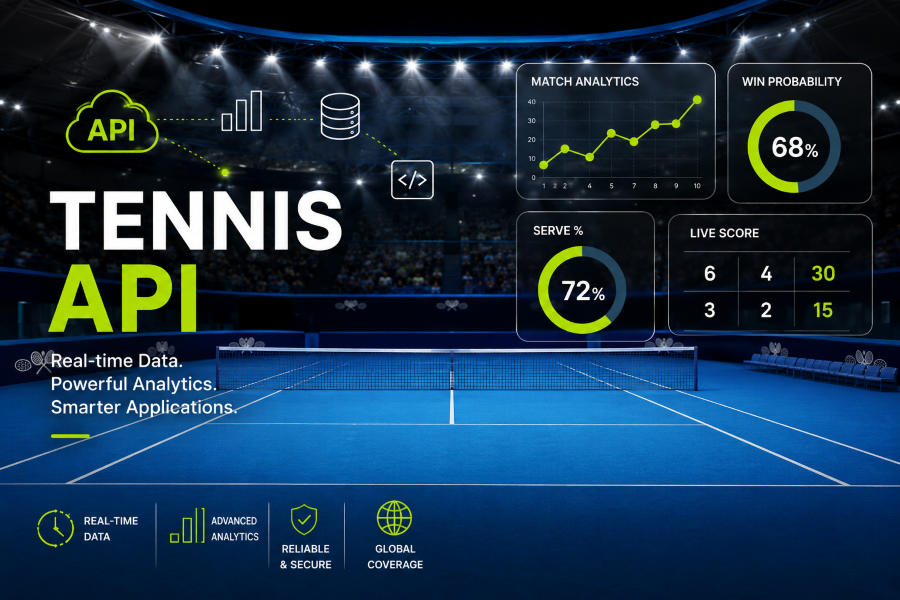
Real-time sports data systems have become one of the most technically demanding areas of modern software development. Among all major sports, tennis presents a particularly interesting environment because of its structured scoring system, rapid momentum shifts, and enormous volume of live statistical information.
Over the last several years, developers building sports applications have increasingly turned to real-time tennis data models to better understand how to process live events, structure predictive systems, and scale analytical infrastructure efficiently.
What makes tennis especially valuable from a development perspective is the combination of simplicity and complexity. The scoring format is highly structured, but the underlying statistical behavior of matches remains extremely dynamic.
As more sports platforms integrate live analytics, machine learning, and probability modeling, real-time tennis systems are increasingly viewed as one of the best case studies for modern sports data engineering.
Tennis Produces Highly Structured Data
One of the reasons developers are drawn to tennis analytics is the sport’s structured event progression.
Every match follows a clearly segmented hierarchy:
- Points
- Games
- Sets
- Matches
This layered scoring system makes tennis particularly suitable for:
- Live event streaming
- Probability modeling
- State management
- Real-time visualization
- Machine learning pipelines
Unlike sports with continuous action, tennis provides naturally discrete events that are easier to process and model programmatically.
This allows developers to build systems that react immediately to scoring changes while maintaining relatively clean event structures.
Low Latency Changes Everything
One of the first lessons developers discover when working with live sports systems is that latency matters far more than expected.
In tennis, momentum can change within seconds.
A single break point conversion may dramatically alter:
- Win probabilities
- Betting markets
- Fan engagement systems
- Live visualizations
- Automated alerts
As a result, live tennis systems increasingly prioritize:
- Fast data delivery
- Efficient caching
- Websocket infrastructure
- Low-overhead APIs
- Real-time synchronization
Developers building scalable live applications quickly learn that even small delays can significantly impact user experience.
Reliable Data Is More Important Than Fast Data
While speed is critical, many developers eventually realize that reliability is even more important.
Fast but inconsistent data creates major problems within:
- Machine learning systems
- Live probability models
- Score tracking platforms
- Broadcast graphics
- Automated trading systems
Reliable tennis data systems must provide:
- Stable schemas
- Consistent match identifiers
- Accurate score progression
- Historical continuity
- Proper error handling
This is why experienced developers increasingly evaluate sports APIs based on infrastructure quality rather than marketing claims alone.
Historical Data Is Essential for Real-Time Models
One common misconception is that live sports systems rely only on current match information.
In reality, most advanced tennis applications depend heavily on historical datasets.
Historical data is used to build:
- Player performance profiles
- Surface-adjusted models
- Probability systems
- Fatigue analysis tools
- Machine learning training datasets
Without long-term historical consistency, real-time models become significantly less accurate.
This is one reason why developers often compare platforms based on historical depth and statistical reliability when reviewing the best tennis data APIs for live analytics and forecasting.
Surface-Specific Modeling Is Extremely Important
One of the defining characteristics of professional tennis is surface variation.
Clay, grass, and hard courts all produce dramatically different playing conditions.
This creates major implications for developers building predictive systems.
Clay Courts
Clay generally produces:
- Longer rallies
- More return opportunities
- Higher physical demands
- Lower serve dominance
Grass Courts
Grass usually favors:
- Short points
- Aggressive serving
- Fast momentum swings
- Higher tie-break frequency
Hard Courts
Hard courts often create more balanced conditions between offense and defense.
Modern tennis models therefore increasingly separate player ratings and statistical profiles by surface.
Pressure Situations Create Valuable Data Signals
Another important lesson developers learn from tennis models is that not all events carry equal importance.
A routine point early in the first set is statistically very different from break point late in a deciding set.
Advanced systems increasingly weight:
- Break points
- Tie-breaks
- Deciding sets
- Pressure service games
- Momentum-changing sequences
These pressure-adjusted models often produce significantly better forecasting accuracy than systems relying only on raw averages.
Real-Time State Management Is Complex
Building reliable live sports applications requires sophisticated state management.
Tennis scoring appears simple on the surface, but real-world systems must handle:
- Medical timeouts
- Suspended matches
- Retirements
- Walkovers
- Rain delays
- Scoring corrections
- Tournament schedule changes
These edge cases create major engineering challenges for live synchronization systems.
Developers quickly learn that handling exceptional events cleanly is just as important as processing standard scoring updates.
Machine Learning Depends on Clean Data
Machine learning systems have become increasingly important within modern sports technology.
Tennis provides ideal conditions for predictive modeling because of its structured scoring and large historical datasets.
Modern systems now train models using:
- Serve efficiency
- Return statistics
- Surface-adjusted ratings
- Pressure performance
- Fatigue indicators
- Historical matchup data
However, machine learning systems are highly sensitive to inconsistent or incomplete data.
Even small structural issues can create:
- Prediction instability
- Model drift
- Statistical distortion
- Incorrect forecasting probabilities
This is why clean historical structuring remains one of the most important aspects of high-end sports analytics systems.
Scalability Becomes Critical During Major Events
Tennis traffic patterns can change dramatically during major tournaments such as Grand Slams.
Applications suddenly experience:
- Massive traffic spikes
- Higher API request volumes
- Increased websocket activity
- Real-time notification surges
- Heavy database load
As a result, scalable infrastructure becomes essential.
Experienced developers increasingly prioritize:
- Load balancing
- Distributed systems
- Edge caching
- Cloud redundancy
- Event queue architecture
Sports applications that perform reliably during peak tournament traffic usually depend on carefully optimized infrastructure design.
Developers Are Building More Than Scoreboards
Modern tennis data systems now support far more than simple score tracking.
Developers increasingly build:
- Predictive analytics platforms
- Fantasy sports applications
- AI-driven forecasting systems
- Coaching analysis tools
- Broadcast graphics engines
- Player scouting systems
- Automated alert systems
This growing ecosystem has significantly expanded the technical demands placed on sports data providers.
The Demand for Comprehensive Coverage Is Growing
Another major lesson from tennis data systems is that coverage depth matters enormously.
Many applications now require:
- ATP Tour coverage
- WTA coverage
- Challenger tournaments
- ITF events
- Junior competitions
- Doubles matches
- Historical archives
Platforms offering broad tournament support through services such as ATP, WTA, Challenger, and ITF Tennis APIs have become increasingly important for developers building scalable sports applications.
Modern Tennis Analytics Is Becoming Increasingly Predictive
Perhaps the biggest lesson developers can learn from tennis data systems is how rapidly sports analytics is shifting toward predictive modeling.
Modern platforms increasingly attempt to forecast:
- Match outcomes
- Momentum shifts
- Player fatigue
- Pressure performance
- Live probability changes
These systems combine:
- Historical databases
- Real-time statistics
- Surface-adjusted modeling
- Machine learning algorithms
- Dynamic probability calculations
The result is a much more advanced analytical environment than traditional sports reporting ever provided.